
Ted as a Man, Not a Case
This year it will be twenty years since the British government granted a statutory pardon to 306 soldiers executed by the British Army during the First World War. It will be 110 years since my ancestor, William Wilfred “Ted” Roberts, was executed for desertion in 1916.
It is interesting to reflect on the fact that, had Ted not been court-martialled and executed, we would probably know even less about him. Many First World War service records were destroyed in September 1940, when a German bombing raid during the Blitz caused a fire at the War Office records repository in London, leaving permanent gaps in the histories of millions of soldiers. War diaries survived, but unless a man was mentioned in dispatches, wounded, or killed, he was unlikely to be recorded in detail.
As well as Ted’s court-martial file, we have his attestation papers from earlier sign-ups in the 1890s, his wounded stripe from 1915, and his pension record. It is only because of the circumstances of his death that more details of his life remain visible at all.
When I try to think about Ted as a man, rather than as a case, I start with the small details, some gathered from census records and his birth certificate. Ted was born on 10 January 1878 to his parents Henry and Alice in Upper Tooting. He was the second of nine children. By 1881, a sister, Kate, had arrived, shown as just one month old in that year’s census. Ted does not appear with the family in 1881, perhaps staying with relatives or neighbours to give Alice some respite.
By 1891, Ted was living with his uncle Alfred, his father’s older brother, whether this arrangement was temporary or longer-term is unclear. In 1901, Ted appears at Wellington Barracks. By 1911, there is no obvious census record for him at all.
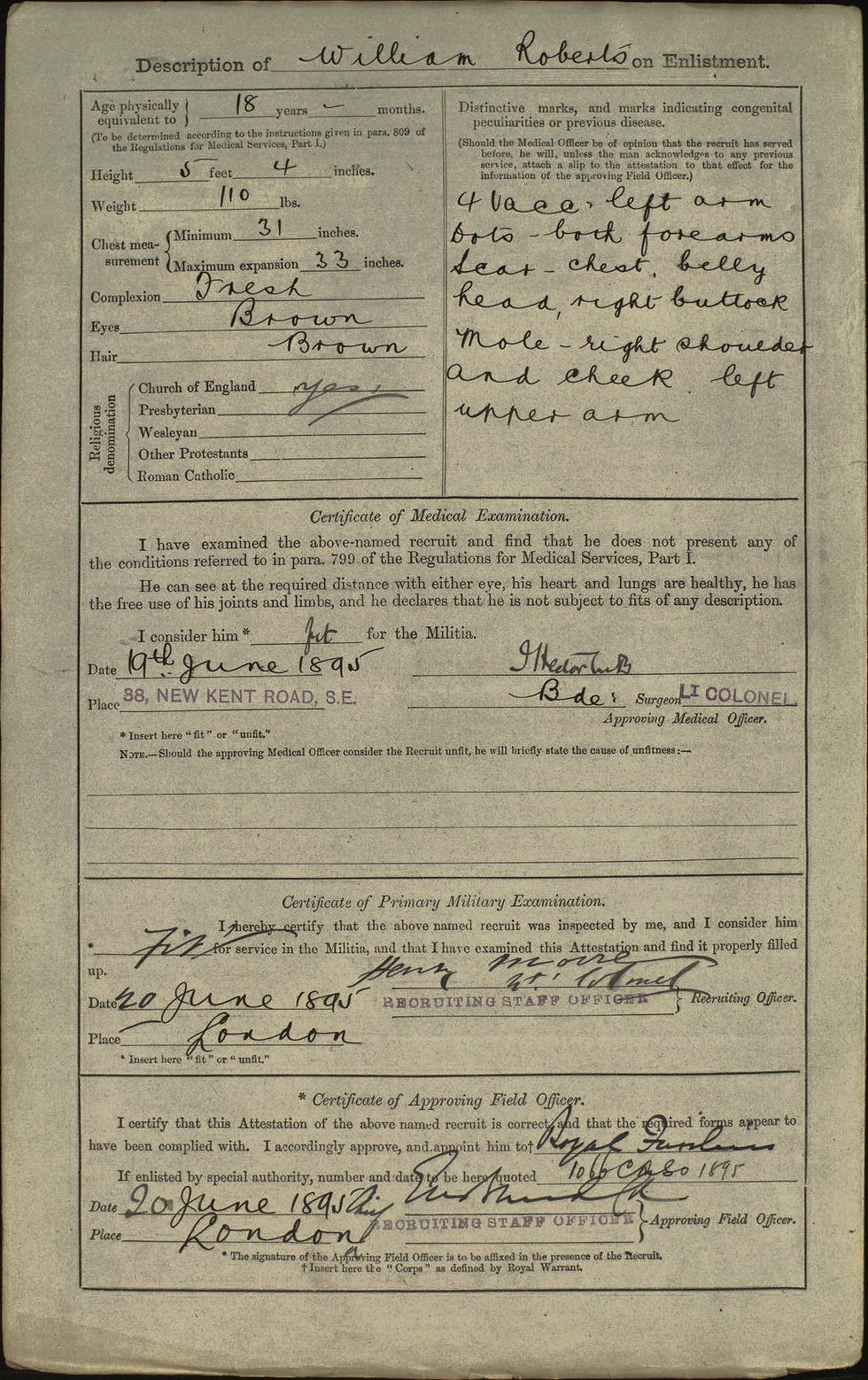
From his attestation papers in 1895 and 1897, we know he was just 5 feet 3¾ inches tall and weighed 110lbs. He had brown hair and eyes and a “fresh” complexion. At 18, he described himself as a labourer. These fragments matter because they remind me that Ted was a real person, moving through different households and institutions long before the war defined his life.
There are details in Ted’s military record that make him feel more like a soldier rather than a set of papers. The physical description again: small, wiry, tattooed, a labourer by trade. Later evidence from his court-martial describes him as “a good and plucky soldier”. He was trusted to go out repeatedly on dangerous work.
According to the evidence given at his court-martial:
“He took part in the action of 16 June 1915 and was wounded. He volunteered on several occasions for dangerous jobs and did his work in the trenches well.”
Another statement recorded:
“Up to the time of this offence he was reckoned a good and plucky soldier.”
Ted himself wrote in his defence:
“I wish to give an explanation in defence of the charge of being absent from my regiment.I took part in the battle of Hooge on June 16th 1915 and was wounded in the head. After leaving hospital I spent twelve days in the firing line and was complimented by the Officer Commanding and Lieut. Col. Sweeney … for general good work in reconnoitring, patrolling and bombing the enemies’ lines … on eleven successive nights.
I cannot account for my leaving the regiment as I have suffered a lot with my head since I was wounded. I often do not know what I am doing. I had no intention to desert but when I realised what I had done I felt too much ashamed to return.
I now throw myself on the leniency of the court wishing you will give me a chance of retrieving my character.”
In the case of millions of other ordinary men, we never hear their voices at all. Diaries were forbidden. Letters home were censored, and many were never kept. Ted’s words survive only because he was on trial.
Further testimony reinforces this picture. Ted stated:
“In the trenches I used to volunteer for all the jobs in front of the parapet every night with Lieut. Nicholson.I have been wounded at Hooge in the head on 16/6/15. For my return to the battalion, I volunteered to join the Bombers.”
A colleague wrote:
“The accused always proved himself to be one of the best men of my company when anything was required doing, whether patrols or finding information.”
Another noted:
“When any dangerous work was on from November 1914 to June 1915 … the accused, if required, always came forward and did good work.”
Alongside this bravery sits a more uncomfortable truth. Ted’s conduct sheet runs to three pages of misdemeanours. While he was clearly capable and courageous, he was also troubled and ill-disciplined. His first charge was recorded at Dover, before he even left for France. As an older soldier, perhaps he was already war-weary before reaching the front.
It feels uncomfortable to acknowledge that Ted was a troublemaker, that he caused his officers time and effort in trying to discipline him. It feels uncomfortable to admit that he deserted his battalion for over six months before being captured. It feels equally uncomfortable to recognise that he was wounded, struggling, and unable to get the help he needed, and that this felt like his only choice.
Each time I look at his file and see the guilty verdict, recorded in such a matter-of-fact way, followed by the sentence of death by firing squad, that discomfort remains.
People often assume that men who were shot at dawn were cowards — that they simply turned away from the guns and ran. The reality is far more nuanced. Many of those executed had already served, been wounded, or been disciplined before. Grouping the 306 men together is difficult, because their ages, circumstances, health, and the processes followed varied so widely.
Ted’s story does not sit easily within a single explanation. In 2026, it still demands attention, not because it offers easy conclusions, but because it reminds us of the responsibility to uncover and share these stories as they truly were, warts and all.


Comments